HELIUS
The engine that turns a thermal inspection into data you can defend.
HELIUS is the system behind every inspection: how the flight is planned, how the original thermal data is preserved, how it is classified and how it is delivered.
Request a demoWhat an orthomosaic is, and what we do
A reconstruction of the mosaic, or the best real capture of each module.
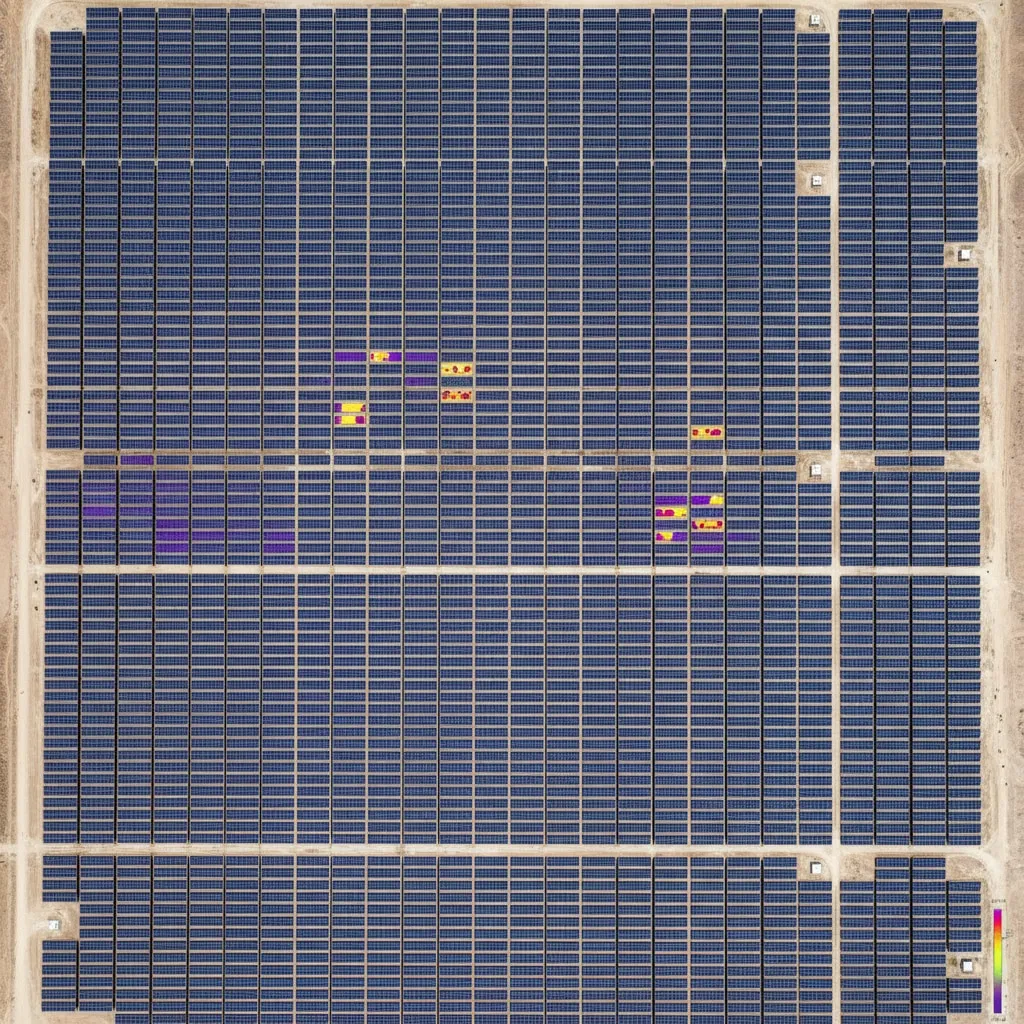
An orthomosaic reconstructs the plant from thousands of images and represents each module through a derived view. HELIUS keeps several real captures of each module, analyses their parameters and selects the best one before feeding it into the classification process.
Orthomosaic
Module cropped from the mosaic
A view reconstructed from one or several captures; its radiometric values depend on processing.
- Thousands of captures are stitched into a single mosaic
- Each module is represented only once
- Derived from a blend of several, without choosing
- A derived view is analysed,
whose radiometry may differ from the original capture
HELIUS
The best of 5–7 shots per module
HELIUS takes several captures, evaluates them, then analyses and classifies the most representative one.
- We capture each module 5–7 times
- We analyse the capture parameters
- We select the best shot
- Only that one goes into the classification CNNs
Deliverables
Everything you receive to decide, compare and justify.
Algorithmic planning
- Algorithm-generated route
- No decisions made in the field
Controlled capture
- Angle relative to the POA
- 5–7 shots per module
- 4 validated variables
Homogeneous raw data
- GSD 3 cm/px
- Radiometric matrix preserved
Selection and analysis
- Selection of the best shot
- CNN on the original data
IEC classification and own criteria
- IEC TS 62446-3:2017 and MUVATECH criteria
Longitudinal traceability
- Comparable history
- The asset’s entire service life
What sets us apart
We analyse what the sensor saw. Not what an algorithm reconstructed.
The orthomosaic helps locate the findings. The original radiometric captures make it possible to review the values recorded by the sensor and the criteria used to interpret each anomaly.

Silent animation, just over a minute long, that sums up how HELIUS works in seven steps. 1, flight: we program the flight with an algorithm-generated route and the same protocol every campaign. 2, capture: every shot overlaps the previous one and the next pass, producing thousands of thermal and visible image pairs. 3, input: an orthomosaic blends the photos into a single stitched image, where the data gets diluted, and is used to view and locate; HELIUS uses the original photos to analyse. 4, selection: HELIUS picks each module’s best shot, perpendicular to the panel, with no reflections and centred, always with the same criteria, so the data is comparable year after year. 5, analysis: three analyses on the real image: we detect the module, read its thermal data and check its visible image. 6, standard: every finding is classified under IEC TS 62446-3, with its CoA severity from 1 to 3 and its action priority. 7, delivery: the result reaches the HELIUS platform, with the anomalies on the map of the plant.
Some methodologies analyse thermal images reconstructed through orthomosaics. Depending on the processing, reprojection, interpolation and blending can alter the original radiometric values and contrasts. HELIUS prioritises the analysis of the sensor’s original captures and uses mapping products to locate and display the findings.
Methodology
A non-comparable inspection builds no history.
A technical history becomes valuable when campaigns apply documented procedures and record the acquisition conditions. This enables longitudinal comparisons and provides evidence for O&M and due diligence.
Early degradation
Comparing campaigns under the same standard reveals trends of progressive losses that a single inspection can never capture.
Validation of repairs
Makes it possible to check whether a thermal anomaly is reduced or disappears after a repair, provided the inspections are carried out under comparable conditions.
Defensible document
Keeping the original captures, parameters and documented criteria makes it easier to review the results technically in audits, warranty claims and asset transactions.
Data journey
What exactly the data loses when it becomes an orthomosaic.
Creating orthomosaics can involve geometric and radiometric transformations that alter the original values, depending on the algorithm. To avoid relying on these transformations, HELIUS analyses the original radiometric captures and keeps their acquisition information.
FAQs
Frequently asked questions
Common questions about the positioning, scope and structure of the solution.
What is HELIUS?
HELIUS is the complete solar solution based on our technology. It integrates standardised capture, panel-by-panel analysis and a visualisation platform for PV assets.
Is HELIUS just an AI model?
No. HELIUS is a complete system for solar assets that integrates capture, analysis and a visualisation platform.
Can it be applied outside solar?
Yes, but that extension is presented as a spin-off of the technology stack and not as the main focus of the public offering.
What does the end user get from the technology?
The end user mainly works with the structured output in HELIUS: findings, history, comparisons and outputs that are useful for operations and reporting.
Would you like to see HELIUS applied to your asset?
If you want to better understand how our technology fits together, evaluate a use case or review how HELIUS fits your assets, this is the place to start.